
Our ParentsAttendance
Text
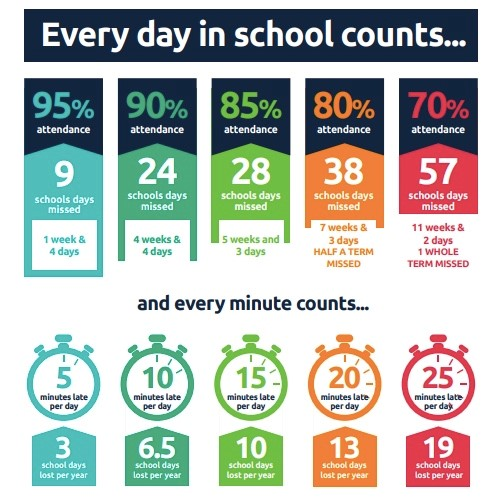
Attending school every day it is open, is essential for giving your child every chance to improve their achievement, strengthen their wellbeing, and support wider development. As parents or carers of a child, you have a legal responsibility to ensure your child receives an education, which is why regular attendance at school is so vital.
Regular attendance is so important
Attending school every day that it is open, is important. Data shows that pupils with higher attainment at Key Stage 1 and Key Stage 2, had lower levels of absence over the key stage, compared to those with lower attainment. This proves that absence from school, even the odd days, impacts heavily on children’s attainment. However, it is not just attainment that is affected, the well-being and confidence of a child can be greatly impacted too. This can lead to lack of friendships, low self-esteem because the work is too difficult and a child not enjoying school.
When can my child be absent from school?
When you register your child at school, you have a legal duty to ensure your child attends that school regularly. This means that your child must attend every day that the school is open, unless:
-
Your child is too ill to attend that day.
-
You have asked in advance and been given permission by the school for your child to be absent on that day due to exceptional circumstances.
-
Your child cannot attend school on that day because it is a day you are taking part in religious observance (only 1 day permitted each academic year)
-
When directed by the school e.g. Snow Day(s)
Be a HERO - Here Everyday Ready On time!
At Oxley we want every Oxley Parker to be a HERO! Being a HERO is easy, you just need to be in school every day and ready to learn on time. Our gates open at 8.30am and close at 8.40am. Your child needs to be in school before the gates close. You know that if you are having to send your child through the front door, they are late. Every day, in every class, learning starts immediately. This can be a range of early morning challenges that revisit previous learning or set things up for the day ahead. If your child misses this or is late for this, it can often make them feel on the ‘back foot’ for the rest of the day.
In our older year groups, our early mornings start with a year group ‘Gathering’. This is where year groups come together to be registered and are given messages on expectations and updates on the day ahead along with learning activities.
These morning slots are also key times when individuals or small groups may receive targeted interventions for their specific learning needs.
All this is lost if your child does not get into school, through the gates on time! We recognise the stresses and strains on families in the mornings. However, it is key that everything possible is done to ensure your child is on time. We are becoming concerned with the increased number of children arriving late, so we really need your help to turn this around. Of course, if you really are struggling, please get in touch and we will always do our absolute best to help in whatever way we can.


Text
What the law states...
Parents and carers have a legal responsibility to ensure their child attends school regularly and on time. This is set out in Section 7 of the Education Act 1996, which states that every parent must ensure their child receives a suitable education. When a child is registered at a school, this duty includes making sure they attend that school consistently.
If a child’s attendance becomes low or continues to decline, the school is required to refer the matter to the Local Authority, who may begin legal proceedings. These procedures must be followed by the school, regardless of personal circumstances, because they are statutory requirements.
Under the Anti‑Social Behaviour Act 2003, the Local Authority may issue a Fixed Penalty Notice. This carries a fine of £80, rising to £160 if not paid promptly. This fine applies per adult and per child.
You may also be asked to attend an attendance meeting with the Local Authority. If attendance or punctuality does not improve, further legal action may follow. This could include a PACE interview (Police and Criminal Evidence Act 1984), which may lead to prosecution in the magistrates’ court under Section 444(1) or Section 444(1a) of the Education Act 1996. Possible outcomes include:
A fine of up to £2,500 and/or up to 3 months’ imprisonment for an aggravated offence
A fine of up to £1,000 and a criminal record for a Level 3 offence
Help and advice: Is my child too ill for school?
If you decide your child is too unwell to attend, please contact the school as early as possible on the first day of absence. You can phone the school office or email attendance@oxleyparkacademy.com to let us know the reason for the absence.
For guidance on common illnesses and whether your child should attend school, please follow the NHS advice linked below.
The good news is that the majority of children at Oxley Park Academy attend well and are thriving in their learning.
Help and Advice. Is my child too ill for school?
If you do keep your child at home, it's important to phone the school as soon as possible on the first day of absence. Please let the office know that your child won't be in and give them the reason. You can also email attendance@oxleyparkacademy.com.
Follow this advice for other illnesses: (please click on the links for more information from the NHS).
|
Condition |
Advice |
|
Coughs and colds |
It's fine to send your child to school with a minor cough or common cold. But if they have a fever, keep them off school until the fever goes. Encourage your child to throw away any used tissues and to wash their hands regularly. |
|
High Temperature |
If your child has a high temperature, keep them off school until it goes away.
|
|
Chicken Pox |
If your child has chickenpox, keep them off school until all the spots have crusted over. This is usually about 5 days after the spots first appeared. |
|
Cold sores |
There's no need to keep your child off school if they have a cold sore. Encourage them not to touch the blister or kiss anyone while they have the cold sore, or to share things like cups and towels. |
|
Conjunctivitis |
You don't need to keep your child away from school if they have conjunctivitis. Do get advice from your pharmacist. Encourage your child not to rub their eyes and to wash their hands regularly. |
|
Ear infection |
If your child has an ear infection and a high temperature or severe earache, keep them off school until they're feeling better or their high temperature goes away. |
|
Hand, foot and mouth disease |
If your child has hand, foot and mouth disease but seems well enough to go to school, there's no need to keep them off. Encourage your child to throw away any used tissues straight away and to wash their hands regularly. |
|
Head lice and nits |
There's no need to keep your child off school if they have head lice. You can treat head lice and nits without seeing a GP. |
|
Impetigo |
If your child has impetigo, they'll need treatment from a GP, often with antibiotics. Keep them off school until all the sores have crusted over and healed, or for 48 hours after they start antibiotic treatment. Encourage your child to wash their hands regularly and not to share things like towels and cups with other children at school. |
|
Ringworm |
If your child has ringworm, see your pharmacist unless it's on their scalp, in which case you should see a GP. It's fine for your child to go to school once they have started treatment. |
|
Scarlet fever |
If your child has scarlet fever, they'll need treatment with antibiotics from a GP. Otherwise they'll be infectious for 2 to 3 weeks. Your child can go back to school 24 hours after starting antibiotics. |
|
Slapped cheek syndrome (also called fifth disease) |
You don't need to keep your child off school if they have slapped cheek syndrome because, once the rash appears, they're no longer infectious. But do please let the school or teacher know if you think your child has slapped cheek syndrome. |
|
Sore throat |
You can still send your child to school if they have a sore throat. But if they also have a high temperature, they should stay at home until it goes away. A sore throat and a high temperature can be symptoms of tonsillitis. |
|
Threadworms |
You don't need to keep your child off school if they have threadworms. Speak to your pharmacist, who can recommend a treatment. |
|
Vomiting and diarrhoea |
Children with diarrhoea or vomiting should stay away from school until they have not been sick or had diarrhoea for at least 2 days (48 hours) |